igfold2d
Interaction overlays
Since v0.2, every residue cell carries a vector of non‑covalent (and covalent disulfide) interactions, computed from the 3D structure. The overlay lets you read the wiring of the fold directly on the 2D proteomap — H‑bond ladders, buried salt bridges, aromatic clusters, and the canonical disulfide — and makes β‑bulges legible as the places where the H‑bond register breaks.
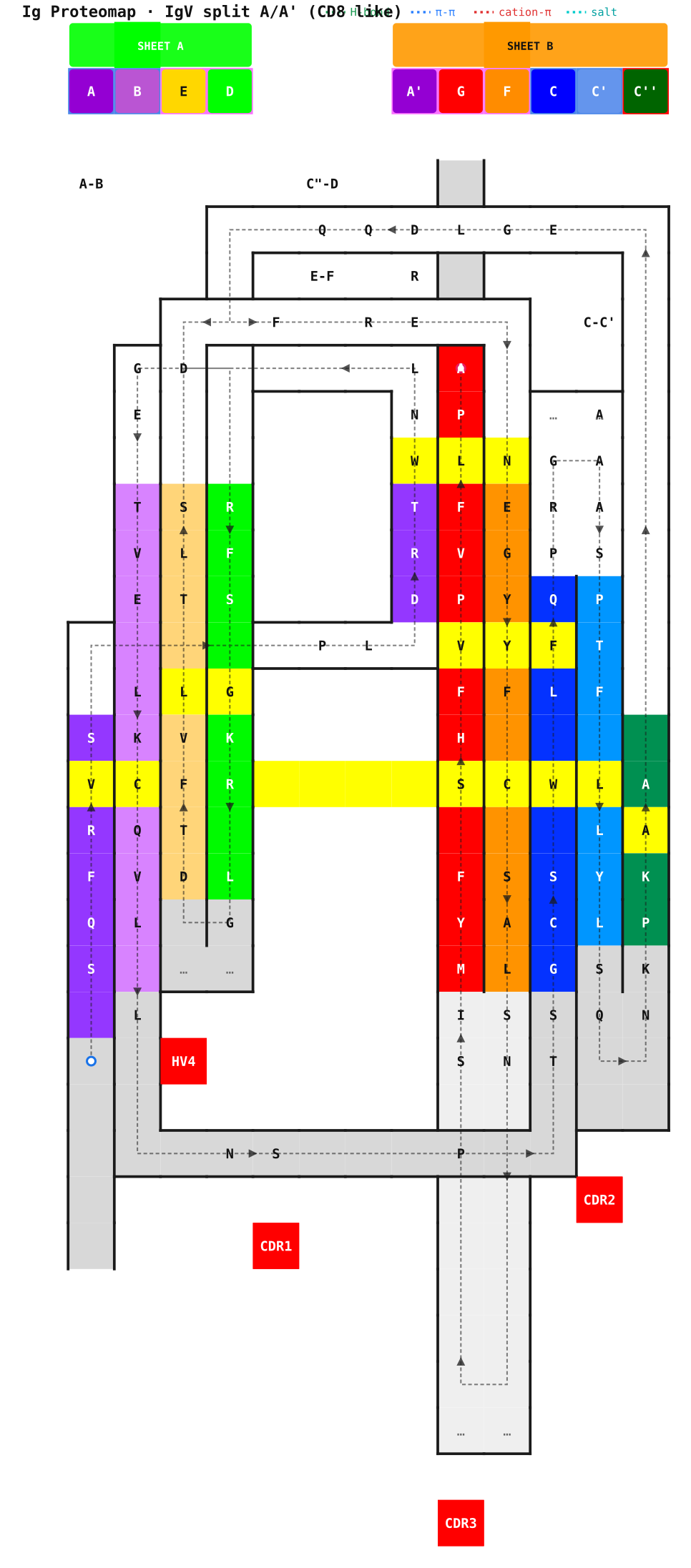
Interaction types & colors
Colors follow the iCn3D convention so the 2D map reads the same as the 3D viewer:
| Type | Line color | Fluorescent cell highlight | Notes |
|---|---|---|---|
| H‑bond | green #22c55e |
#5bff8f |
backbone (bb), backbone–sidechain (bs), sidechain (ss) |
| Salt bridge / ionic | cyan #00e0e0 |
#5bffff |
Asp/Glu ↔ Lys/Arg/His, ≤ 4.0 Å |
| π‑stacking (π–π) | blue #0b2fd6 |
#6a86ff |
aromatic ring centroids ≤ 6.5 Å |
| cation‑π | red #ef2d2d |
#ff6b6b |
Lys/Arg ↔ aromatic ring, ≤ 6.0 Å |
| disulfide | yellow #f5c400 |
#ffe680 |
Cys SG–SG ≤ 2.5 Å (drawn as a thick bridge) |
| halogen | magenta #d63dd6 |
#ff86ff |
reserved; none in CD8α |
| contacts | grey #9aa0a6 |
— | reserved |
Interacting with the map
- Hover a residue → tooltip lists its interaction partners (
→= donates,←= accepts for H‑bonds), labeled by residue + PDB number + strand. - Click a residue → the side panel shows the full interaction vector with distances and bond subtype; the residue and its partners light up with fluorescent backgrounds and solid contact lines. The clicked residue is colored by its most‑relevant interaction type.
- Click a partner in the panel → navigates to that residue and redraws the network from there, so you can walk the interaction graph.
- Cmd‑click (macOS) / Ctrl‑click (Windows/Linux) → add or remove residues from the selection, combining several local subnetworks into one view.
- Click a strand label (A, B, E, D, A′, G, F, C, C′, C″) → selects the whole strand; click a SHEET A / SHEET B header → selects the whole sheet.
- “Show all” toggles (H‑bonds, salt, cation‑π, π–π, S‑S) → draw the entire network of that type across the domain, cumulatively, as faded dotted lines.
- IgStrand colors toggle → neutralize strand fills to grey so interaction lines and highlights stand out.
Convention: dotted lines = whole‑network overview (toggles); solid lines = the focused selection’s local network.
Reading β‑bulges
A clean antiparallel β‑ladder puts each cross‑strand H‑bond partner on the same grid row. A β‑bulge breaks that: one residue H‑bonds to two consecutive residues on the partner strand, at different rows. On the map this appears as a residue whose two green H‑bond lines fan out to adjacent rungs. In CD8α the B–E and F–C interfaces show this pattern (e.g. E‑strand F84 wired to both G15 and E16 on the B strand).
Data format
assignments/CD8a-P01732.interactions.json is keyed by IgStrand number:
{
  "7556": {
    "hbonds": [
      { "dir": "donate", "label": "E16(B)", "igs": 2544, "kind": "bb", "dist": 3.11 },
      { "dir": "accept", "label": "G15(B)", "igs": 2543, "kind": "bb", "dist": 2.82 }
    ],
    "salt":      [],
    "pipi":      [ { "label": "W12(A)", "igs": 1850, "dist": 6.49 } ],
    "catpi":     [],
    "disulfide": []
  }
}
Each partner carries its igs (IgStrand number) so the widget can resolve the
partner’s cell for drawing lines and navigation. The vector is open‑ended — new
channels (e.g. cation‑π to His, hydrophobic contacts, per‑residue burial) slot
in as additional keys and render with the same line/halo machinery.
Recomputing interactions
tools/compute_interactions.py derives the vectors from a PDB/mmCIF file with
explicit hydrogens (e.g. an iCn3D “save files → PDB” export). See the script
header for geometric criteria and usage. Output is keyed by PDB residue number;
map to IgStrand numbers via the assignment file.